
Can a Robot Write a Symphony? Can You?
#AICreativity #ElephantArt #AIMusic #AISoul

In this article, I use the terms “art”, “artist”, “artworks” and the like, to mean creators across all domains of expression - be they painters, composers, dancers etc.
“Can a robot write a symphony? Can a robot turn a canvas into a beautiful masterpiece? Can you?” Just four years ago Jeff Vintar’s infamous quote from his screenplay iRobot, commanded a fair amount of anxiety as picture generators like DALL·E and MidJourney launched onto the mass-market alongside Chat GPT. Now, with Deep-Fakes and Voice-Cloning becoming increasingly sophisticated, and fake social media accounts auto-spreading disinformation for governments and corporations across the globe, people are rightly curious about the future of the artist as a profession, and whether pictures, poems or music created by these algorithms represent true creativity, and thus legitimate art. The question clamours evermore urgently; what does it ultimately mean to be unable to distinguish a human creation from a non-human one? The question however, is not nearly as novel as you might believe.
Let us be clear, we’ve frequently mistaken abandoned objects in galleries for ‘art’, and computers have been able to produce music and artwork of passable quality for many years. Ever been on hold to your electricity supplier? You know: “Your call is important to us, please stay on the line until it’s no longer important to you!”. The music you hear looping in your ear, and subsequently in your dreams that night, is part of the whole genre of Muzak - bland background music which scarcely bore the signature of human creativity back in the ‘40s and has since passed out of human influence entirely. Indeed, in many spheres of creative endeavour, computer thinking has surpassed human capabilities, and has integrated itself in the living world.
Leaving aside Computer Assisted Design (CAD) and 3-D Printing, consider how the world of Chess has integrated the microchip revolution into its culture. For some like world champion Magnus Carlesen, there is a melancholy associated with this. In recent years he has admitted to a certain nihilism when considering long-form chess, as computer engines have analysed every one of the thousands of feasible opening lines many moves deep, making the kind of contemplative creativity that the classical form engenders, nigh on impossible. Chess’ most powerful and mystical draw is summed up in its famous description - as being both composition and performance simultaneously. What is left for the professional player without the threat of the unknown; without the space to make new worlds in their own image? The so-called ‘Mozart of Chess’ is the last of the GMs to have learnt his craft as much from books as computers. He is a signpost at the cross-roads we have passed. What do we learn from looking back down that road? Not much about AI specifically, but we do see how the humans in that culture changed and delineated themselves from the non-human world. Players now instinctively see what is an ‘engine move’ as supposed to a human one, and such metrics are often used to assess cheating. There is an acceptance of a certain kind of knowledge only knowable to computers that is distinctly alien, that lacks a certain aesthetic charm. In short, even on the chess board, we sense a disturbing lack of humanity.
Animal art says more than AI
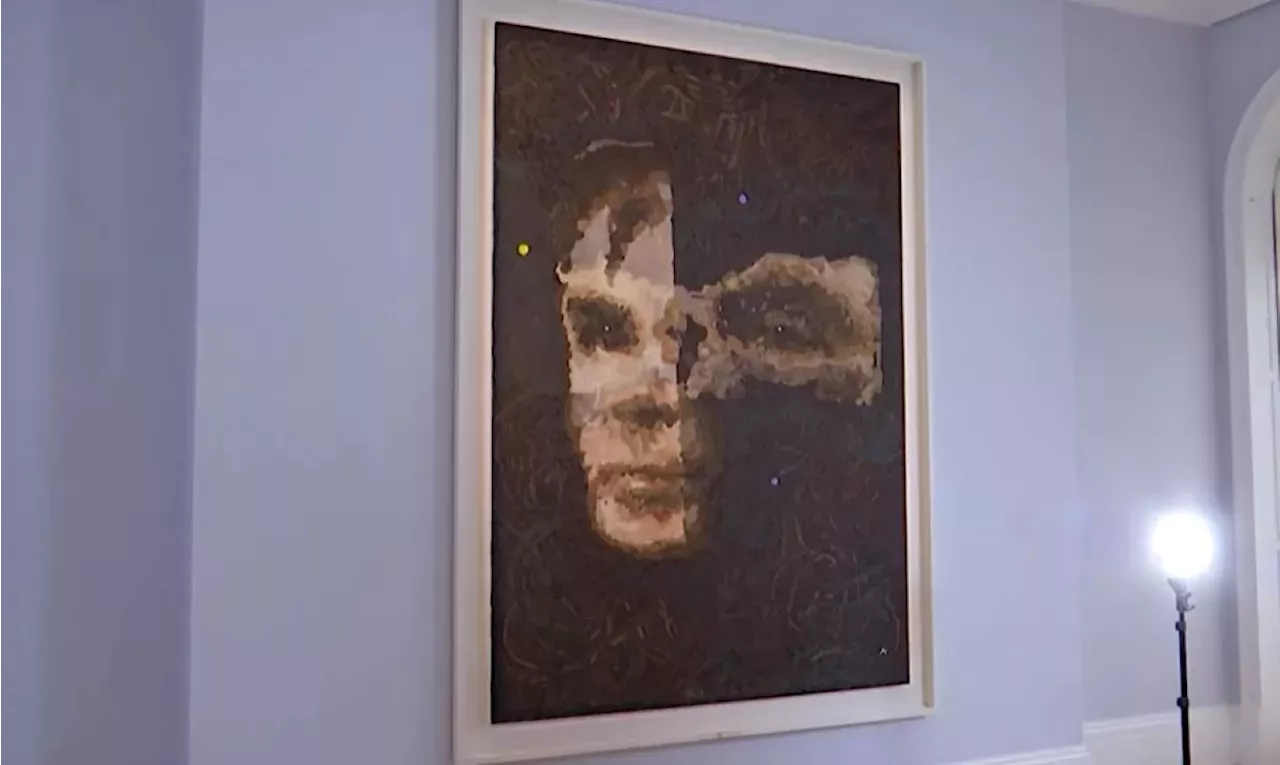
Yet, we sense no lack of ‘humanity’ in art produced by animals. Elephants and Apes have consistently shown a desire to draw merely for pleasure, as supposed to obligation. They’re inspired like any 2 year old child, by observing and imitating their human care-givers. We find this art captivating. The famous painter-elephant Suda can reproduce trees and other elephants with remarkable fidelity, but her talents are not confined to her. Elephant art shows a consistent affinity of representation in contrast to Ape art which is abstract, but not random. These pictures sell for hundreds of dollars, and exhibitions are always popular. What draws us to these works more humanly than AI art? AI robotics can certainly produce legitimately indistinguishable artworks. Just this month, a large canvas by the robot Ai-Da sold for over 1 million pounds at Sotheby's, London. This is no reliable guide to long term value however.
Many have argued that AI algorithms are simply regurgitating a melange of salient facets from the vast quantity of human blood, sweat and tears they’ve been trained on. The paintings and compositions are somehow fundamentally unoriginal? This to me is a shaky argument. All human creative responses are a result of the influences they are trained on. Those small fragments perceived as original we call inspired, but when one drills down into it, very little indeed is truly Divinely dictated. Music is replete with great works of art heavily inspired by other composers; Mozart’s Requiem, Beethoven’s ‘Moonlight’ Sonata, Schubert's Sixth Symphony scherzo: all works copiously borrowing styles and harmonies from their particular mentors. Or consider one of Shakespeare’s most famous lines: “Double, double toil and trouble”. Few realise this is not actually his own, but rather a quote from the Roman historian Homer. No, let us dig deeper. What separates AI art from animals’ is a sense of innocence. Animal art is naïve, AI art is unconscious.
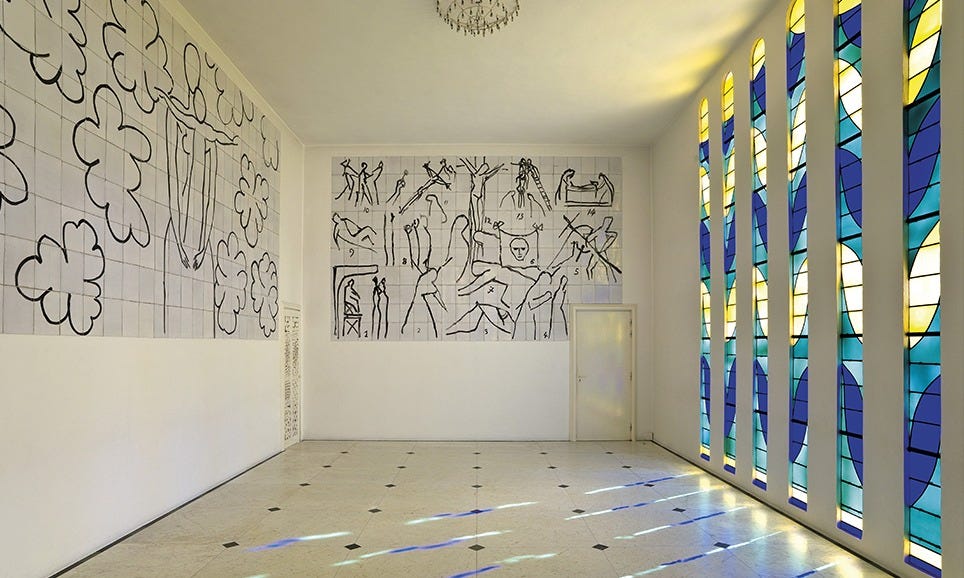
Naivety in art is frequently venerated as the purest form of expression. Artists can spend years developing styles that obversely seek to negate the cultivated and learnéd techniques of their discipline; think of Henri Matisse’s chapel, or Arvo Pärt’s tintinnabuli compositions. These creations reflect the innate strivings of all people for a Return To Innocence - to a state of childlike unknowing, or natural unconsciousness. Such desires are the common themes of religion, art, and the environmental movement.
Yet we cannot perceive such traits in AI art, and here is the crux of the matter. We can perceive many things in artistic creations that illuminate their interpretations, but the thing we cannot perceive in AI creations is gravity - that sense of being in the world. Only by being in the world can one experience gravity. It pulls constantly on our bodies, alters our appearance, and aches our joints and souls in equal measure. Music is organised spatially, it defies and is pulled by gravity. Great works of music have the capacity to absorb the reflexive gaze of the listener, who projects onto it an implicit assumption that the composer can have the same experience. It is a quality placed over the music and not intrinsic to it. If there is no sense of this reciprocal nature, the piece is devoid of being - in the literal sense of not being in the world - and thusly, not Being at all. Without Being, one cannot be innocent, one is merely unconscious. Certainly, Professor Sergey Levin of Berkeley University’s robotics department thinks like many others; that a physical body is fundamental to a common understanding of intelligence and consciousness.
Creative Pieces Speak as well as Listen
An artwork lives as much by what the listener or viewer brings to it, as well as what is wrought into it by the artist - whomever they, or whatever it may be. It is though, a kind of fractal boundary - the more we stare into the frontier, the more complex and ineffable the delineation. But if we ultimately believe that beauty is in the eye of the beholder, then AI can certainly produce legitimate works of creativity that have profound meaning. Goethe writes: “The dignity of Art appears perhaps most conspicuously in music; for in music there is no material to be deducted. It is wholly form and intrinsic value, and it raises and ennobles all that it expresses.” I am convinced we will see eternal works of AI art. To the extent that those works live into the future, will be as rare as those produced by humans. We can be melancholy about it if we choose; we have after all lost our innocence as to the nature of creativity. But we can also learn to delineate between conscious and unconscious pieces, and satisfy ourselves that there is a truth expressed by a living Being that cannot be expressed by a non-living one.
We are very far from the development of the kind of artificial intelligence that is as embodied and vulnerable in the living world as us. In the meantime, we should not be shy about acknowledging our insufficiency in recognising conscious and unconscious art. We should also be unashamed to promote the fundamental difference between us, as a legitimate boundary that limits the pallet of expression for the robots. Why? Because a great work of art must both speak and be heard. One can only imagine what is said by the silent.